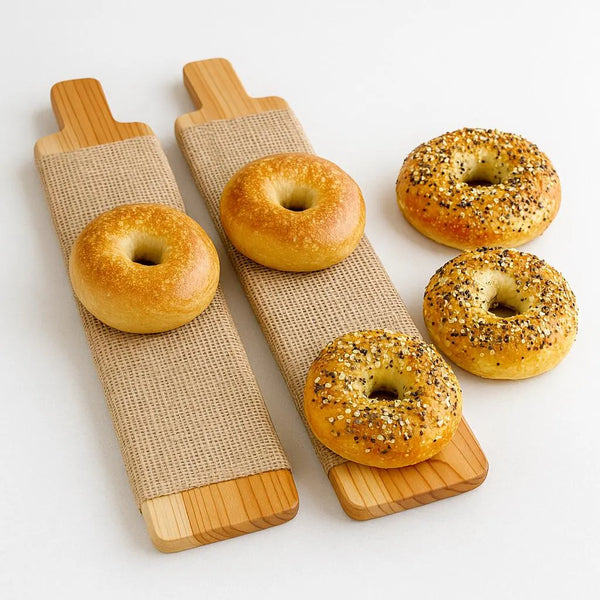
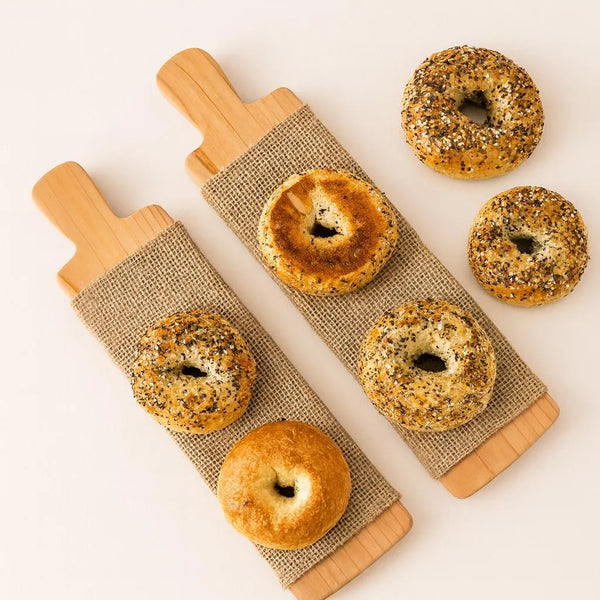
You pulled a tray of flat, dense bagels out of the oven and you want to know what did it. The eight causes below are listed in the order I would check them. Most of them I have produced myself, in my own kitchen, at 6,000 feet in Colorado Springs, baking on cedar boards.
One assumption before the list. This page assumes a real bagel recipe, with a high-protein flour and a boil. If you adapted a soft sandwich-bread recipe, that is the diagnosis. Start from our Authentic New York Bagel Recipe and come back if the problem survives.
It also assumes wheat. Gluten-free bagels fail on different physics, and they have their own article.
Flattened in the fridge overnight? That might be normal
If your bagels went into the refrigerator plump and came out shorter, that alone is not a failure. I measured this on a recent sourdough batch with calipers. My control bagels settled 15 percent overnight and still baked up the tallest of the batch, with the best crumb. Cold dough relaxes and settles; some morning shrink is built into the process. The bagels I deliberately overproofed settled 25 percent, and the skin told me more than the height: slack and wrinkled instead of taut and slightly puffed. Tight skins, bake with confidence. The full measured comparison is in Why Are My Sourdough Bagels Dense, Flat, or Gummy?
1. Underproofed dough
Dense is usually a proofing word. Dough that goes into the water before fermentation has done its work bakes into a heavy ring with a tight crumb, whatever else went right. It is the first thing I rule out, and my fix was unglamorous. I started running the float test on every batch. Drop one shaped bagel into cool water; if it floats, the batch is ready.
Now the caveat, because the float test gets treated like gospel. Mine sometimes fails it and bakes out fine anyway. A bagel can sink to the bottom of the boiling water, sit there for a few seconds, then rise and bake out fine. Treat the test as a signal, not a verdict. Sinks and stays down: underproofed. Sinks and comes back up within seconds: probably fine. I have since confirmed this in a measured batch: straight from the fridge, even the best bagels of the weekend sank at first, then rose within seconds as the water warmed them. Cold dough is dense dough.
2. Boiling too long
Most published recipes call for a one to two minute boil per side, and I followed that advice while my bagels did their rising in the pot instead of the oven. The surface sets around a puffed ring, and by the time it reaches the oven there is no spring left. I boil 20 seconds per side now. That is enough to set the crust and nothing more. If your bagels balloon in the water and come out of the oven flat, this is the first number to cut.
The same overboil shows up on the surface too; if your skins pucker instead of flattening, see Why Did My Bagels Wrinkle After Boiling?
3. Shaping with the poke method
Rope beats poke. Poking a hole in a dough ball and stretching it is faster, and it is what most tutorials teach, but it builds almost no tension in the ring. The rope method (roll a log, wrap it around your hand, seal the seam under your palm) puts a tight skin on the bagel, and that tension is what holds the ring tall from the proof all the way through the oven. A batch that looks fine after shaping and slumps before it reaches the water usually has a shaping problem, not a proofing one.
We later put calipers on this: the measured three-method comparison is in The Best Way to Shape Bagels.
4. Too much water
Bagel dough is supposed to fight you. Mine runs at about 58 percent hydration, drier than nearly any other bread dough, and that stiffness is what lets a ring hold its shape through a long proof. Over-hydrated dough proofs into rings that spread sideways and never recover.
I did this to myself with a batch of blueberry bagels. I mixed in whole berries I had frozen myself, straight from the freezer, and I did not think to reduce the water, because the berries were still solid when I mixed them. As the cold ferment went on they thawed and let their juice into the dough, and the dough became an over-hydrated mess. The batch baked flat. It still tasted great. The lesson: anything you add that carries water counts as water. Reduce the dough's water to match.

5. No steam in the oven
A bagel needs humidity for its first minutes in the oven. The ring blooms before the crust locks, and a dry home oven locks it early; you get a set crust wrapped around dough that never finished rising. This is the failure that put me on boards in the first place. A soaked cedar board is a simple machine, wet wood and wet burlap holding steam right against the dough: the bagel bakes topping-side down for about seven minutes, blooming while the surface stays soft, then flips onto the stone to finish. It is the century-old New York fix, though any way of holding moisture in the oven through those first minutes helps. The full mechanics are on our Why Bagel Boards page.

6. Baking at altitude without adjusting
This one only applies if you live high, but where it applies it explains a lot. Lower air pressure speeds the yeast up, and dry mountain air pulls moisture from the dough as it proofs, so a sea-level schedule quietly stops fitting. My adjustment is small: slightly less yeast and a little more water, without crossing into the over-hydration problem from cause four. Altitude punishes big corrections.
7. A baking surface that's too hot
Steel moves heat into dough faster than stone does, the way a metal railing in the sun burns your hand when a wooden one does not. That is its appeal for pizza and its problem for bagels: the base sears and sets while the ring is still trying to rise, and you get a flat bagel with a scorched bottom. I burned bottoms this way until I changed my setup. The fix is the same idea as cause five: put something between the dough and bare metal for the opening minutes of the bake, then let the hot surface finish the bottom.
The full surface-by-surface verdicts are in What Should You Bake Bagels On?

8. A weak sourdough starter
If your bagels are sourdough, check the starter before anything else on this list. Bagel dough is stiff and low in water. That is a hard environment for any culture, and a starter that is less than strong and well fed will under-ferment the dough no matter how patient you are. An under-fermented bagel is cause one wearing a different name. Get the starter to a strong, recently fed peak before it touches bagel dough. My worst batch ever traced to exactly this, a levain that took far too long to double, mixed anyway because the schedule said it was time. When I later reproduced underfermentation on purpose and measured it, those bagels came out the same way: dense and tight with a gummy center.
When two causes stack
The stubborn batches are usually two of these at once. Over-boiling can hide underproofing, and a hot steel makes a marginal batch look worse than it was. Change one variable per batch, starting from the top of this list, and you will usually have your answer inside two or three bakes. Change three things at once and you have built a new mystery.
Where to go next
The recipe: the exact process I bake every weekend, in grams, is the Authentic New York Bagel Recipe.
The method: why steam decides the bloom is on our Why Bagel Boards page.
The gear: the boards that fix causes five and seven are in the boards collection.