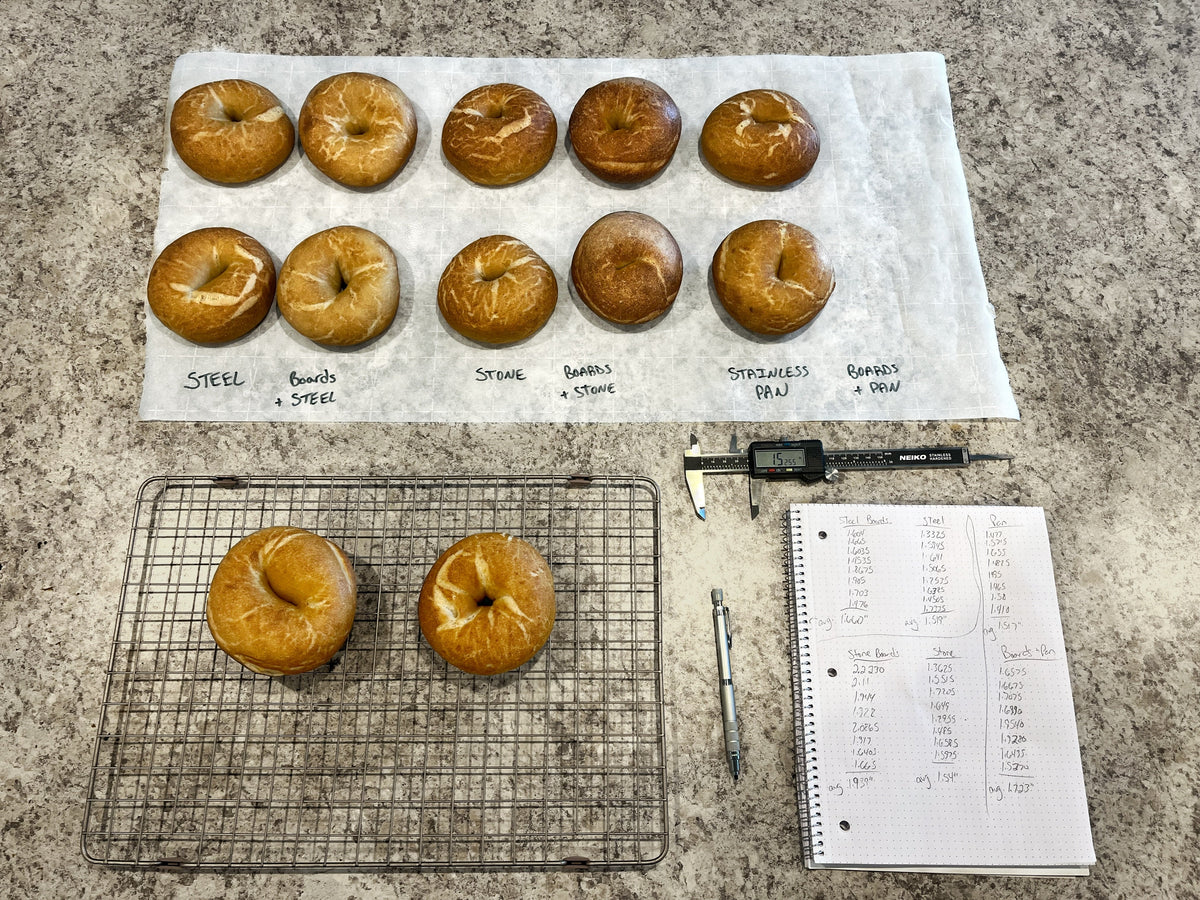
If your oven already holds a pizza steel or a sourdough stone, you own most of what a bagel bake needs. Keep it. My steel goes in for every batch, preheated to 450°F with the oven, and it stays. It just doesn't work alone. A bagel spends the back half of its bake pressed against whatever surface you chose, and at 450°F that choice carries as much weight as the recipe does. I've baked bagels on steel and on sheet pans. Boards have gone onto the bare rack, and batches have landed on parchment after the flip. And in August 2026 the calipers came out: twelve bagels from one dough, baked across all three surfaces with and without boards. Here is each surface, where it fits and fails, and the numbers behind the verdicts.
What the surface decides
The top of a bagel browns in open air and mostly takes care of itself. The bottom is the contested territory. Metal conducts heat hard and fast, stone banks it and pays it back steadily, wet wood shields the dough from it entirely, and paper does nothing but keep dough and metal apart. A bagel bake has a use for every one of those behaviors, in a particular order: gentle and wet early, hard and hot late. That order is why my honest answer to this article's question is a sequence of surfaces, not a single purchase.
The 12-bagel

The trial ran twelve bagels from a single batch of dough, shaped together and cold-proofed in one fridge, then baked in three rounds, one round per surface: baking steel, pizza stone, sheet pan, each preheated at 450°F. Every round carried four bagels. Two started upside down on soaked cedar boards and flipped onto the host surface at the seven-minute mark, my standard method. Two baked directly on parchment the entire time, which is exactly the setup people cite when they argue boards are unnecessary. I took four caliper readings on each bagel at equal quarters and averaged them.
A home oven runs one round at a time, so the rounds went in series, the way any home bake has to. Series baking comes with a built-in check: bagels in later rounds sat in the fridge longer, so if cold-holding time mattered, the direct cells would drift across the day. They didn't. The last round out of the fridge measured like the first.
| Setup | Avg height | Oven spring | Total bake | Bottoms hit the rescue point |
|---|---|---|---|---|
| Steel, direct | 1.519" | +31% | 18 min | minute 7 |
| Steel, boards first | 1.660" | +43% | 22 min | minute 13 |
| Stone, direct | 1.540" | +32% | 17 min | minute 13 |
| Stone, boards first | 1.939" | +67% | 25 min | minute 18 |
| Sheet pan, direct | 1.517" | +30% | 18 min | never; the bake ended first |
| Sheet pan, boards first | 1.723" | +48% | 25 min | never |
The rescue point is the minute a bottom darkened enough that I'd normally move the batch to a room-temperature sheet. One bagel of each pair got that move so both endings are photographed, and it never changed a height; spring is set before bottoms brown. Oven spring is measured from the shared post-boil baseline of 1.163 inches, and every round came out at matched top color, so the bake times are comparable.
Read the direct rows first. Steel, stone, and sheet pan, baked direct, landed within 0.023 inches of each other. That's less than a thirty-second of an inch, a gap you couldn't feel with your thumb. Every forum argument about which surface to buy is a fight over that gap. Now read the board rows. Boards won on every surface: by 9 percent on the steel, 26 on the stone, 14 on the pan. Pool all twelve and the six board bagels averaged 1.774 inches, the six direct 1.525. Sixteen percent taller, and the spring gap was wider still: 52 percent with boards, 31

So the question in this article's title turns out to be smaller than it looks. What's under the bagel barely matters. What the bagel spends its first seven minutes on decides the bake. The trade is time: matched to the same top color, board rounds ran 4 to 8 minutes longer than their direct twins. Gentle is slow. The height column is what the extra minutes buy.
The tallest cell of the day stacked the two gentlest bottoms: boards over the stone, 1.939 inches, 67 percent oven spring. The theory the next experiment gets to test: the later a bottom sets, the longer the bagel keeps rising. The result isn't confined to my oven, either. Andrew of Andrew Kneads to Eat measured about a centimeter more oven spring on boards in his own kitchen. He repeated it. It held.
Each cell here is only a pair of bagels, measured eight times between them, and the whole trial ran through a single home oven in a single day. Nothing got sliced, so how these eat is a question for a later batch. What the trial does have is heights, bake times, and twelve photographed bottoms; for the surface question, that's enough.
The verdict table
| Surface | What it does well | What it costs you | Verdict |
|---|---|---|---|
| Baking steel | Strong, fast finish for the back half of the bake | Burns bottoms fastest: direct-baked bagels hit the rescue point at minute 7 | Keep it. Finisher, not starter |
| Pizza stone | Same finishing job, gentler: direct bagels held to minute 13 | Round shape fights the flip; absorbs drips, smokes later | I prefer the steel; two catches below |
| Sheet pan | Room-temperature rescue when bottoms darken early; mildest host in the trial | Bare metal under raw dough at full bake burns bottoms first | Landing zone and brake |
| Parchment | Non-stick landing after the flip | Weld risk when raw dough meets paper without real heat under it | Behaved from raw on preheated surfaces; zero risk after the crust sets |
| Soaked cedar boards | A gentle start: shields raw dough, steams the skin. Measured: 16% taller bagels | Needs any surface above to finish the bake, plus 4 to 8 extra minutes | The starter. Works on a bare rack |
Where the steel wins, and where it burns
If you bake pizza, you know what a steel does: it slams heat into whatever touches it. That power cuts both ways. The steel finishes the back half of my bake, and left unwatched it torches bottoms, which is why I check them mid-bake, every batch; it only takes a few minutes to go from browned to black.
The trial timed it. Baked direct, bottoms crossed my rescue threshold at minute 7 of an 18-minute bake, the earliest of the three surfaces. Started on boards, minute 13. Six extra minutes of margin is the difference between hovering at the oven door and setting a timer.
Between steel and stone, I prefer the steel, and heat isn't the reason. A steel is a rectangle. Bagels come off a board in a straight row, and a rectangle catches the whole line. It also handles more than bagels; I cook plenty of other things on it.

The pizza stone's two catches
On paper a stone does the same finishing job: thermal mass under the bake. The two catches that push me to steel instead are housekeeping and shape. Stone is porous, so oils and liquids soak in, and what soaks in eventually comes back as smoke. And most stones are round. That matters at the flip, when a straight row of bagels wants a straight landing strip; on a circle the ends run out of room and the bagels don't all stay on, so you're rearranging hot dough to fit the shape. If the stone is what you own, those are the two things to plan around.
The trial did hand the stone two wins. It's gentler than steel, holding direct bagels to minute 13 before the bottoms needed help. And with boards on it, the stone made the trial's tallest bagels. What it didn't do is rescue the skeptic's setup: parchment on a hot stone, the arrangement that supposedly makes boards pointless, produced 1.540 inch bagels while the weakest board cell produced 1.660.
Sheet pan: wrong start, useful brake
My earliest bagels baked at 450°F straight on the metal, no boards, and the results were consistent: burned bottoms, flatter rings, everything seasoning scorched before the bagels set. Raw dough can't ride hot metal for a whole bagel bake. The bottom finishes first. (The flatter part of that story has its own article.)

The same pan comes back at the other end of the bake. If the bottoms are getting too dark partway through, I move the batch to a room-temperature baking sheet and put that in the oven; cool metal slows the burn before it's too late.
In the trial, the preheated pan was the mildest host of the three: its direct pair rode parchment the full 18 minutes and never crossed the rescue line. Don't read that as a win. Those were also the trial's floor at 1.517 inches, and my scorched early batches sat on the bare metal with no parchment. The pan is fine equipment. Raw dough on its bare face for a full bake still isn't a plan.

When parchment works (and when it welds)
Most people bake bagels directly on parchment, raw, and the dough fuses to the paper; The Fresh Loaf's bagel threads are full of that exact autopsy. Parchment takes the blame for a timing mistake. A just-boiled bagel is soft and tacky, and pressing it against anything for a full hot bake, paper included, is asking it to bond. When a batch of mine lands on parchment, it lands late, on a sheet riding the hot steel: the bagels have already spent their first seven minutes upside down on the boards, so the skin that touches paper has set. Set crust doesn't stick.
The trial softened my warning a notch. All six direct bagels rode parchment from raw, boiled and dripping, on fully preheated surfaces, and none of them welded. I'd still rather give a bagel's first minutes to steam than to paper, but if you're baking without boards, a genuinely preheated surface under the parchment is your sticking insurance.
The first seven minutes belong to the boards
Boiled bagels go topping-side down onto soaked cedar, and the boards go straight into the oven. The dough never meets hot metal raw. The wet wood keeps the face of the bagel off the high heat while steam coming off the burlap keeps the skin from drying out; the full mechanics are on our Why Bagel Boards page. Then the flip, at the seven-minute mark. Tip the board and the row rolls off onto the steel, right side up, for about fifteen more minutes. The boards in these photos are our cedar-and-burlap kind; if you're weighing wood against aluminum, or thinking about building your own, that comparison is its own article.
The trial let me measure what the boards are actually doing in there. Seven minutes into a 450°F bake, an infrared thermometer read the burlap under the bagels at 105°F. The bagels weren't riding a 450 degree surface; they were resting on damp cloth barely warmer than bathwater while the oven browned their tops. The board spent 26 grams of its soaked-up water in those seven minutes, and the exposed cedar handle read 173°F at the flip, nowhere near char. A soaked board isn't a baking surface. It's a shield.
Do you need a baking stone for bagels?
No. The trial measured exactly this: baked direct, the steel produced 1.519 inch bagels, the stone 1.540, the plain sheet pan 1.517, a spread too small to taste. The boards don't care what's under them either; they won by real margins on all three hosts. Mine sit on the steel because the steel happens to take up my entire oven rack, and I've baked without it too: boards straight on the bare rack, flip onto a sheet pan. If a steel or stone already lives in your oven, use it. But bagels don't require the purchase, and the rack you already have is a fine place to start.

What bagel shops bake on
New York bagel shops mostly run deck ovens; an open hearth turns up here and there. The oven floors are often stone, and the ovens do nothing but bagels. I've been to enough of them to know. The boards they load are the same idea as mine, just longer, built to hold more bagels per row. Traditional bakeries still run wood boards; some switch to aluminum for commercial volume. That tradition is a New York thing, and it's the honest reason people fly there for the pizza and the bagels; shops elsewhere moved to more modern, commercial setups because it's convenient, and the difference shows up in the bagel. It was never the water.
Where to go next
Bagel Boards vs. Proofing Boards vs. Aluminum: which board to put in the oven, once you've picked what goes under it.
Why Bagel Boards: the steam-and-set mechanics inside the board stage.
Our bagel boards: the cedar-and-burlap pair from these photos, built in our Colorado Springs workshop.