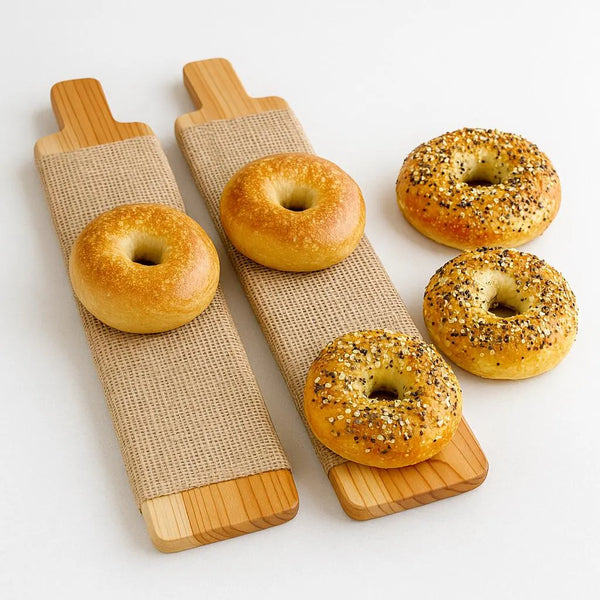
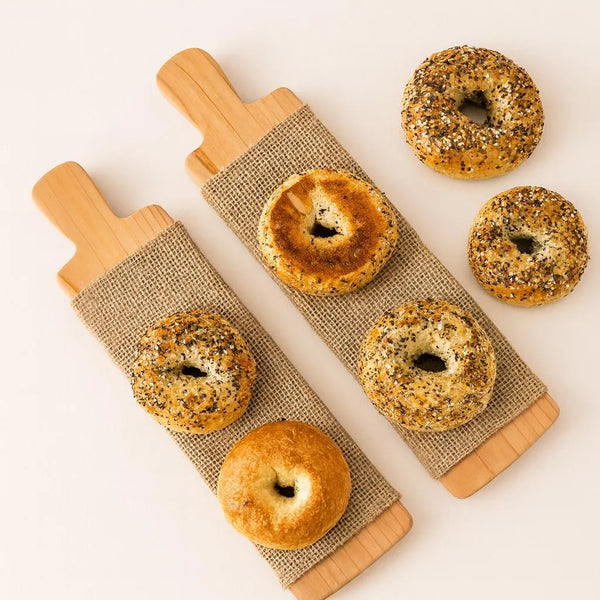
If you’ve ever stood behind the counter of a legendary New York bagel shop, you’ve likely seen them: stacks of weathered wooden planks tucked near the massive deck ovens. To the uninitiated, they look like scrap lumber. To a baker, they are the single most important piece of hardware in the room. A bagel board is a water-soaked cedar plank, traditionally wrapped in burlap, that allows a home oven to do something it wasn't designed to do: inject steam directly into the heart of the bake.
The Heritage: Solving the Stone Hearth Problem
The history of the bagel board begins in the basement bakeries of the Lower East Side and the Bronx in the early 1900s. Back then, bagels were baked in massive, coal-fired stone hearth ovens. These ovens were incredibly hot but bone-dry.
The Baker’s Flip
Historically, the board wasn't just a steamer; it was a transport system. A master baker could load a dozen boards into a deck oven in seconds. After five minutes, when the bagels had bloomed (reached their maximum height), the baker would perform the flip. With one fluid motion, the boards were inverted, dropping the bagels directly onto the stone hearth to crisp the bottoms while the burlap-protected toppings finally met the heat. This two-stage process is what creates the distinct contrast of a real bagel: a lacquered, egg-shell thin crust and a soft, chewy interior.
Why Wood Beats Metal
You’ll often see home bakers try to replicate this with parchment paper or aluminum sheets, but the physics don't hold up. Metal is a conductor; it gets hot fast and stays dry. Wood is a thermal mass that holds moisture in its fibers. When a soaked cedar board hits a 450°F oven, it doesn't just sit there, it works. It releases a steady, controlled steam that keeps the bagel’s skin pliable.
As a woodworker, I look at these boards as functional machinery. We use untreated Western Red Cedar and petroleum-free burlap because the materials are part of the recipe. The wood breathes, the burlap grips, and the result is a bagel that looks like it came out of a 1940s Brooklyn basement, even if it was baked in a modern Colorado kitchen.
Where to go next
-
The Method: If you’re ready to see the science of the "soak and flip" in action, visit our Why Bagel Boards method page.
-
The Recipe: Ready to start your first batch? Our Authentic NY Recipe is the perfect place to begin.
-
The Gear: Shop our handcrafted boards and starter kits to bring this tradition into your home.
- Comparing the five things sold as bagel boards? Start with the honest guide