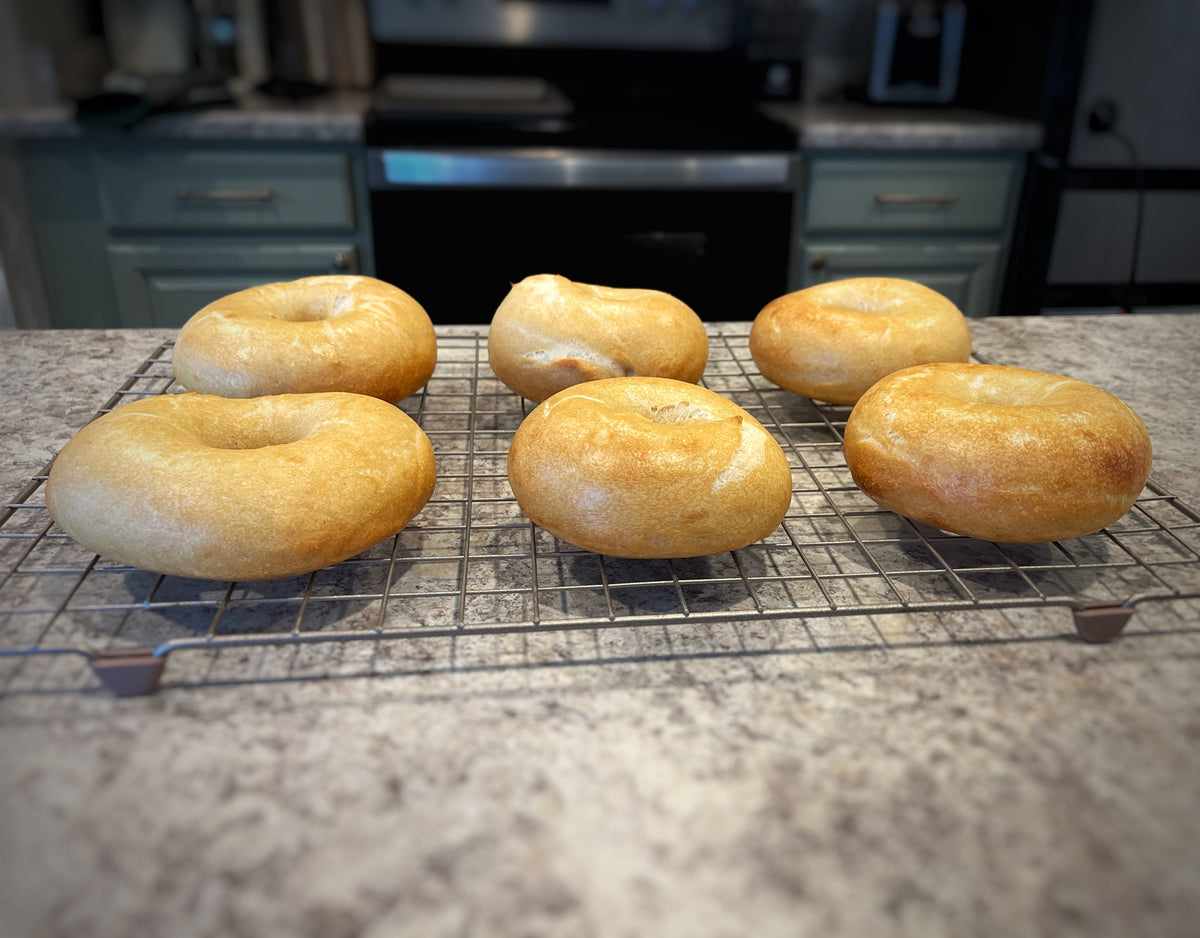
Every bagel guide tells you how to shape; almost none of them can tell you what the shaping costs you, because nobody measures. So I did. I took one batch of my standard dough, shaped two bagels each with three different methods, and ran calipers over them at three checkpoints: after the cold ferment, after the boil, after the bake. Same dough, same water, same boards, same oven. The short version: the laminated log finished tallest and smoothest, the rope tied it for height at half the shaping time, and the poke finished about 15 percent shorter than the log and out of round. It never led at any checkpoint. The bench decides more than the oven does.
The three shaping methods, and what they cost at the bench
The poke. Push a thumb through the center of a dough ball and widen the hole. This is the method most tutorials teach because it is fast and nearly foolproof. It is also the fastest here: my baseline for shaping time.

The rope. The traditional shop method, formally rope-and-loop: roll the piece into a rope, wrap it around your hand, and seal the seam under your palm against the counter. Took me twice as long as the poke.

The laminated log. I have never seen a settled name for this one, so I am naming it: press the dough piece flat into a sheet, roll that sheet up into a tight log (that is the lamination, layers of dough rolled over themselves), then wrap and seal like a rope. The rolled-up sheet builds tension in layers the way a rolled towel holds itself stiff. Twice the rope's time again, so four times the poke.

Across six bagels the difference is negligible. The more you bake, the more that time scale adds up.
The test
One batch of the dough from our bagel recipe, divided six ways, two bagels per method. Barley malt syrup in the boil this time instead of the brown sugar and honey the recipe lists; everything else per the recipe. Sixteen hours of cold ferment, 20 seconds per side in the water, then onto soaked bagel boards on the steel at 450°F with the usual flip. I measured height with the calipers from my workshop and averaged the two bagels in each pair; lumpy tops got an averaged height rather than a single spot. Two bagels per method out of one batch in one kitchen is a real test, not a laboratory. Treat the pattern as the finding.

What I measured
| Method | After cold ferment | After boil | After bake |
|---|---|---|---|
| Poke | 0.750" | 0.969" | 1.485" |
| Rope | 0.8385" | 1.102" | 1.7105" |
| Log | 0.8860" | 1.156" | 1.7415" |
Three things in that table matter.
The order never changes. Log over rope over poke after the ferment, after the boil, after the bake. Sixteen hours of proofing, a rolling boil, and a 450°F oven all had their chance to reshuffle the ranking between the refrigerator and the finished bagel, and none of them touched it. Whatever tension you build in shaping is the tension you bake with.

The boil is a photocopier. Every method grew 29 to 31 percent in the water. The pot enlarged each bagel by the same factor and preserved every difference between them. If a ring goes into the water slack, it comes out bigger and just as slack.

The oven is where the rope fought back. Bake growth ran 53 percent for the poke, 55 for the rope, 51 for the log. That spring pulled the rope to within 0.031 inches of the log at the finish line, a tie for practical purposes. The poke sprang too, but from too far back, and it finished 13 to 15 percent short of the other two.
Height is only half the report. The log pair came out the smoothest and most uniform of the six, two near-identical domed rings. The rope pair finished tall but showed some cracking and small irregularities. And the poke pair lost more than height: by the end of the bake they had visibly drifted out of round.

The verdict
The laminated log is probably the shaper I'll use most from here. Tallest of the six, and by far the smoothest. The layered tension survives everything the process throws at it, and its cost is honest: four times the poke's shaping time.
The rope is the volume play. It matched the log's height at half the shaping time; it just wore more of the effort on its face. When I am baking a lot of bagels, the rope is the one I'll reach for, and I suspect the time math is exactly why it became the shop standard: my guess is that a bakery shaping that kind of volume every morning settled on the fastest method that still builds real tension.
The poke is speed and nothing else. It finished flatter, and it was the only method that came out of the oven no longer round. If you bake for the joy of a quick Sunday batch, it will still make you bagels. They will just come out shorter, by about 15 percent on this test.
What it means for your next batch
If your bagels come out of the oven shorter and flatter than they went into the water, look at your hands before you blame your oven, because the surface tension a ring carries out of shaping is the ceiling on everything after. Flat has other causes too, proof and boil among them, and those are ranked in Why Are My Bagels Flat and Dense. Rope beats poke. It costs double the poke's shaping time and buys most of the log's height. And if you want the version worth photographing, laminate: flatten, roll, wrap, seal.
Where to go next
Authentic New York Bagel Recipe: the exact dough, boil, and bake these six bagels ran on.
Why Are My Bagels Flat and Dense?: the full flat-bagel diagnosis, shaping included.
Our bagel boards: the burlap-wrapped boards under every bagel in these photos, built in our Colorado Springs workshop.