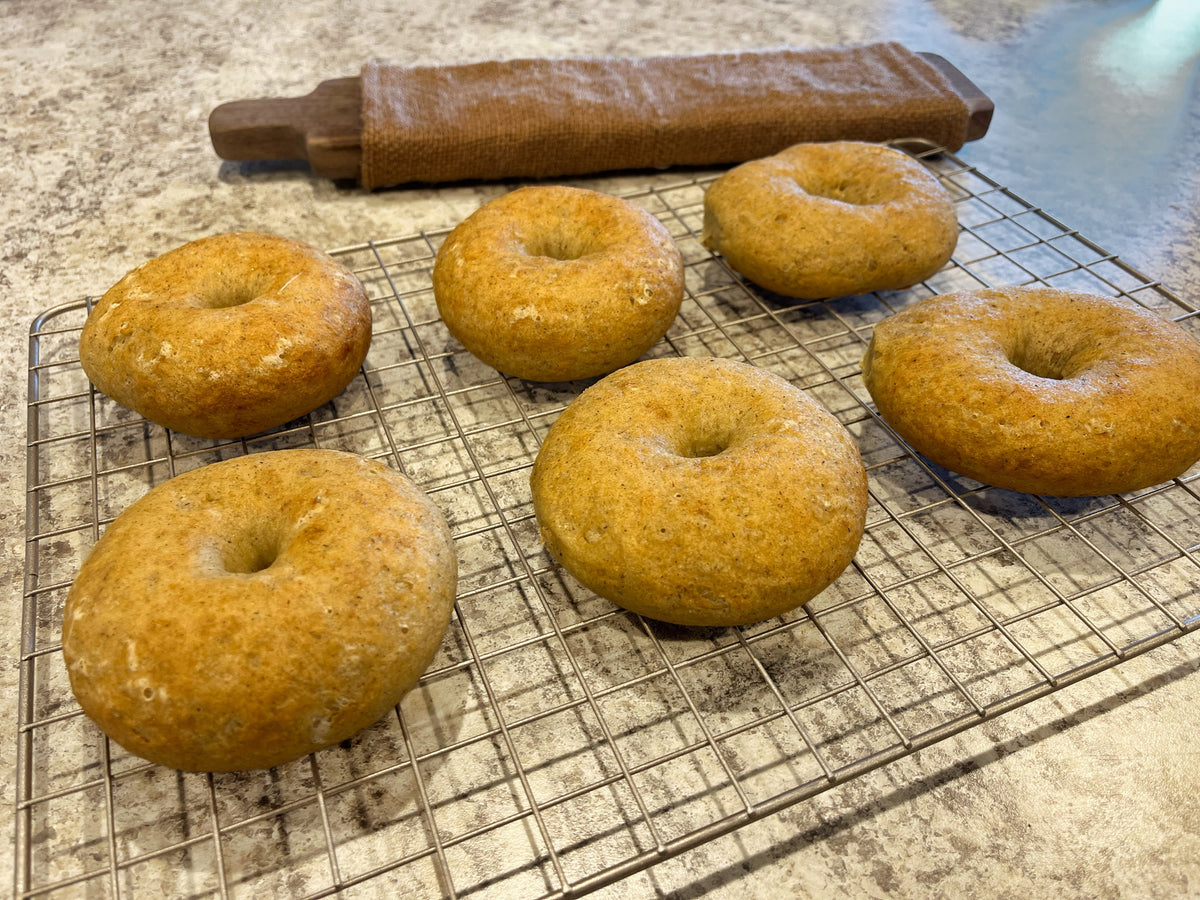
Gluten-free bagels fail in ways wheat never warns you about: rings dense as hockey pucks, dough that breaks apart in the boiling water, tops split with cracks, middles that read gummy. I've made most of these myself. My weekly batches are wheat, but the gluten-free recipe in our kit came out of test bakes with different flours and methods, and the early attempts went wrong in nearly every direction. Here are the failures, most common first, with what causes each one and what fixed it.
What gluten was doing for you
Gluten is the joinery. In wheat dough it forms a stretchy net that traps gas from the yeast, holds the ring together through a rolling boil, stretches over the oven spring, and gives the finished bagel its chew. Take it out and you're assembling parts without fasteners. Gluten-free flour still brings flavor and body. It just can't hold anything together. Every failure below traces back to that missing part.
Cause 1: the dense brick
Along with crumbling, the failure I saw most, and the heaviest. The bagel bakes up squat and tight, closer to a dumpling than a bread.
Two things starve a gluten-free bagel of its rise. Less gas gets held in the first place, since nothing traps it, and what little puff the dough manages is fragile enough that plain drying will take it away. Before I built our blend I tested store-bought gluten-free dough, and it did not work. Most GF bagels come out very bland, not puffy, and dry without a mix built for the job; that failure is the reason our kit's mix exists.

The half of the fix you control at the oven is steam. I bake gluten-free on soaked cedar boards the same way I bake wheat: the bottom sets against the board first while the steam keeps the surface from drying out. Without the boards, a flat bagel. The mechanics are on our Why Bagel Boards page.
Cause 2: they fall apart, in the pot or under the knife
The boil is where weak gluten-free dough dies. A wheat ring rides out twenty seconds of rolling water because gluten holds it in one piece; a gluten-free ring has nothing doing that job unless you gave it something. Some of mine broke up right in the water. Others survived the bake, then crumbled the moment a knife touched them.
The something is a binder. Mine is psyllium husk. Mixed into the dough it forms a gel that helps the ring keep its shape through the proof and the boil. Our Gluten-Free Bagel Making Kit is built around that fix: the psyllium arrives pre-measured in its own packet, alongside the dough mix and the boil additive.

If yours hold together until you cut them, look at cooling too. A gluten-free crumb needs to finish setting on the rack; slice warm and it crumbles or smears.
Cause 3: the cracked surface
Cracks across the top were a regular sight in my test batches. The cause is a dough with no stretch. A wheat skin expands when the inside pushes on it; a gluten-free skin tears.
Shaping is where you fight back. I roll my wheat bagels into ropes and would tell you to do the same, but rope-shaping a gluten-free dough is a good way to break it, since the dough snaps instead of stretching. Here the poke method wins: push a thumb through the middle of a ball and widen the hole gently. Less pulling on a dough that can't take it.

What about the gummy middle?
Gummy is the failure people search for most and the one missing from my own list, so this fix is the gluten-free community's, not mine. GF bread bakers converge on two culprits: an underbaked center, which is why many of them pull loaves at 205 to 210°F internal, and slicing too early. I don't run a thermometer on bagels. The cooling rest matters either way: a warm crumb hasn't set yet, so give it rack time before you judge the bake.

The boil changes without malt
The classic New York boil runs on barley malt, and barley is a gluten grain, so the traditional route is off the table here. My gluten-free pot gets brown sugar and baking soda instead. The sugar caramelizes the outside; the baking soda helps the browning along. My best-looking batch took a tablespoon of baking soda in the water.
Timing starts at my wheat standard, twenty seconds per side. Gluten-free dough isn't rising the way a wheat dough does, so you can go a little longer in the water if you want to develop the outside more. They do still risk breaking up in the pot; holding the ring together through the boil is the psyllium's whole job. The float test dies here too. It reads the rise. There's no rise to read.
Why gluten-free bagels fail wheat recipes
If your batch started as a wheat recipe with the flour swapped, this is the pattern underneath everything above. A classic bagel recipe assumes gluten at every station: the knead exists to develop it, rope shaping borrows its stretch, the float test reads its rise, and the malt in the boil comes from a barley field. Swap the flour and every step is asking for an ingredient that isn't in the bowl. Gluten-free needs its own recipe.
How good can a gluten-free bagel get?
Honestly: very good, and not identical. I made a batch for my wife and she couldn't taste a difference from wheat. When I posted my best gluten-free batch to r/Bagels, a commenter called them some of the finest-looking gluten-frees they'd seen, and added that most people make a lumpy mess of GF.
The gap that remains is texture. The chew is real chew, but it isn't wheat chew, and a gluten-free crust struggles to take on the tight, glossy New York skin. My own note under that Reddit post says it plainly: happy with the taste, still chasing that last bit of the classic NY look. Everything under that ceiling is reachable in a home kitchen, taste and puff included.
Where to go next
The Gluten-Free Bagel Making Kit: the dough mix, the psyllium packet, the brown-sugar boil packet, two cedar boards, and the tools.
Why Are My Bagels Flat and Dense?: this article's wheat sibling, with its own causes and fixes.
Why Bagel Boards: the steam mechanics that keep a bagel, wheat or not, from drying flat.