Search for bagel boards and you'll find five different products wearing the same name: cedar planks wrapped in burlap, aluminum boards with metal clips, bare wood proofing boards, DIY plans, and budget three-packs of thin pine. They are not interchangeable. The one that produces bagel-shop crust in a home oven is the traditional pattern: a water-soaked wooden board, wrapped in food-grade burlap, that holds your bagels topping-side down for the first minutes of the bake. The rest of the answer is about materials, and it includes a few cases where the right choice is not the one I sell. I build cedar bagel boards in Colorado Springs; here is how the options compare.
Why a board at all
I didn't start with boards. My first batches went onto sheet pans and a baking steel, and the steel did what steel does: it seared the bottoms before the tops finished rising. The bagels came out flatter than they should have been, with scorched bottoms. Everything seasoning burned before the dough had even set, batch after batch.
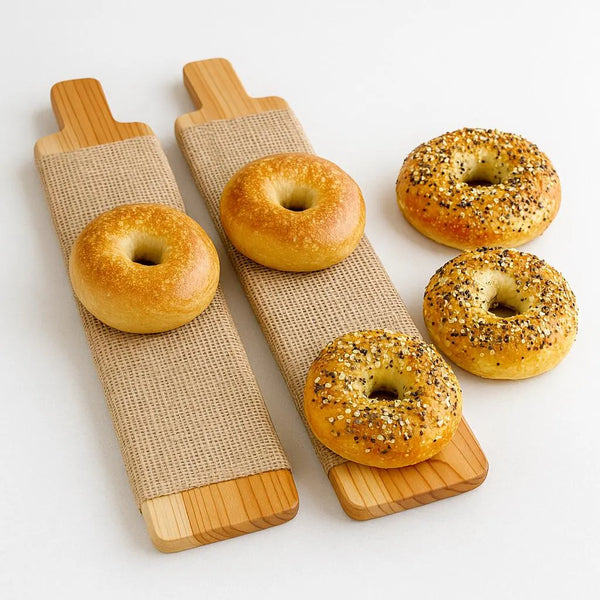
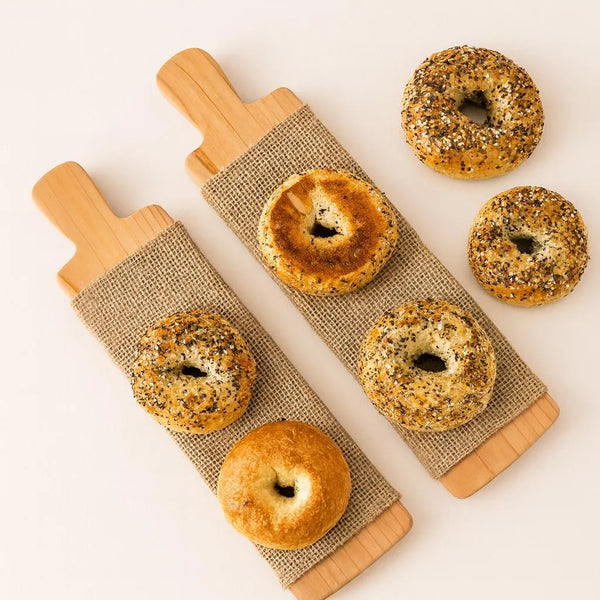
A boiled bagel entering a dry 450°F oven needs two things at once: steam around the dough so it can finish expanding, and protection for the toppings until the crust firms up. A soaked board delivers both in one move. The bagel goes topping-side down onto wet burlap; the burlap steams the dough and shields the seeds; after about seven minutes you flip the bagel off the board onto the stone to crisp the base. The full mechanics are on our Why Bagel Boards page, and the history is in What Is a Bagel Board. This article is about the hardware.

The five things sold as a "bagel board"
| What's listed | What it actually is | Oven tool? |
|---|---|---|
| Traditional cedar boards | Cedar plank, burlap tacked over one face. The century-old shop pattern. | Yes |
| Aluminum turning boards | Metal core, burlap held on by clips. Commercial length, usually over two feet. | Yes, in a deck oven |
| Proofing boards | Bare wood boards that hold shaped dough before the boil. No burlap. | No |
| DIY builds | Big-box lumber plus fabric-store burlap. | Yes, with two cautions |
| Budget multi-packs | Thin boards, often pine, often unspecified materials. | Yes, for occasional use |
One terminology trap. Commercial suppliers file most of these under "proofing boards," because in a bagel shop the boards do double duty holding retarded dough. If you're shopping for the oven tool, you want the burlap-faced board. Bare proofing boards hold shaped dough before the boil.
What matters in the wood
Cedar earned this job over a century of shop use, and it earned it on two properties. It survives being soaked over and over without rotting, and it holds that water deep in its fibers, releasing steam across the whole bake instead of flashing it off in the first minute. I build with untreated Western Red Cedar partly for those properties and partly out of respect for the tradition.
Pine is a different story. I won't build boards from it: pine warps too easily, and a warped board doesn't sit flat on the stone.
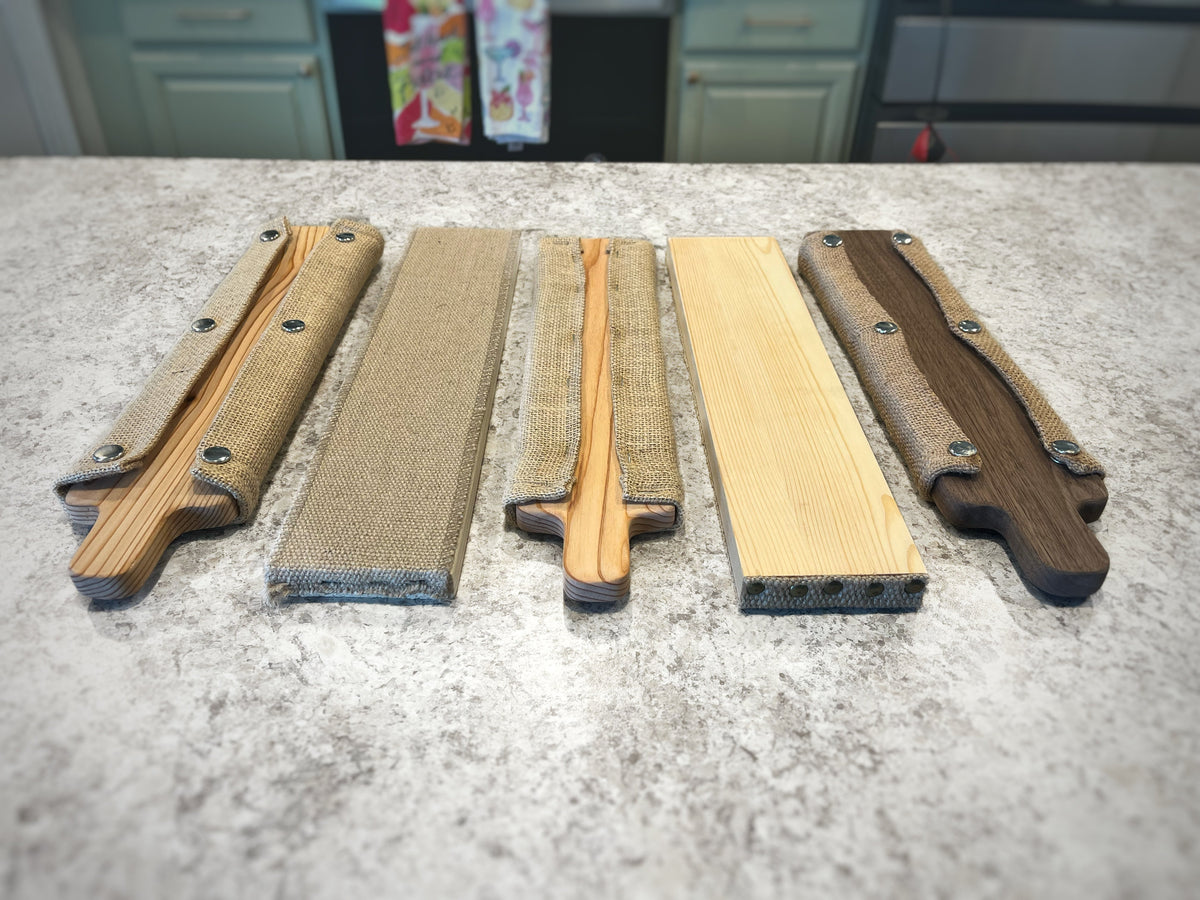
My personal boards at home are walnut Signatures, because I'm a woodworker and I like looking at them. They bake identically to the cedar. I have found no performance difference at all, and the extra cost buys figure and color, nothing else. If a maker pitches you a premium wood as a performance upgrade, keep your hand on your wallet.
The aluminum question
Commercial aluminum turning boards are honest equipment. Aluminum never rots, never warps, cleans fast, and the clips let a shop swap worn burlap covers in seconds. Bakeries buy them for reasons that have nothing to do with your kitchen.
For a home baker they solve problems you don't have and give up the thing you're buying a board for. Standard commercial boards run about 25 inches, sized for deck ovens rather than a home range. And an aluminum core carries no water. Every bit of steam has to come from the thin layer of wet burlap, because metal holds heat but not moisture. Soaked wood is a reservoir; it keeps feeding steam through the minutes when the dough is still expanding. I've never run a wholesale line, so I'll take the shops at their word on the economics. In a home oven, wood is the right call.
Building your own
If you're confident with tools and bake a few times a year, building boards is a genuinely good project. Two material warnings first, because they are the difference between a weekend project and a mistake.
First, the cedar at big-box stores is mostly milled for fences and decks, and much of it is treated for outdoor use. Treated lumber has no place under food. You want untreated cedar, and you may have to dig through the rack or ask for it.
Second, fabric-store burlap is not food grade. Commodity burlap is commonly processed with petroleum-based batching oil; food-grade burlap is processed with vegetable oil instead. The two look identical on the shelf. Buy burlap sold explicitly as food grade, or keep dough off it.
Buying cheap
A budget set is a fine place to start if you bake occasionally. Before you buy, check three things in the listing: the wood species (skip pine), the word "untreated," and the words "food grade" next to the burlap. If a listing names none of them, that silence is your answer.
What more money buys is simpler than it sounds: materials you don't have to second-guess (the food-grade burlap and untreated cedar from the sections above), and construction that stays flat through years of soaking. Whether that's worth it depends entirely on how often you bake. If bagels are a monthly habit or better, buy once.
What I changed after years on traditional boards
My first proper boards were traditional cedar rectangles, the same pattern shops have used for a hundred years, and the bake they produce is exactly right. Two things about them drove me crazy anyway. There is nothing to hold, so pulling a plank of hot wood off a 450°F stone with an oven mitt is an awkward moment you repeat every bake. And the burlap traps what it catches: I could see dough stuck under the fabric and had no way to reach it.
Those two complaints became the two boards I build. The handle on the Classic Bagel Board exists because of that oven-mitt moment. The snap-off burlap covers on the Signature Bagel Board exist because of that trapped dough: the covers snap off so the wood washes bare, and a worn cover gets replaced instead of the whole board. I still own my traditional rectangles, and they still bake fine. I just stopped enjoying them.

A test one of our customers ran
I can tell you what I see in my own oven, but I'm the least objective person available. Here is part of a review a customer left after buying their first boards and running a side-by-side on their own:
"I even did a test, baking on boards, baking just with steam, and baking without steam or boards. The bagels baked on the board measure 1cm high[er] (better oven spring) than those baked without [steam] and moisture. Additionally, the bagels baked on the boards also produced a shinier, glossier crust."
One centimeter of extra rise and a glossier crust, measured in a home oven by someone with no reason to flatter me. They ordered more boards afterward.
Which board should you buy?
The same sorting I give anyone who asks:
- Handy with tools and bake occasionally: build your own from untreated cedar and food-grade burlap; it's a one-weekend project.
- Not sure the hobby will stick: a budget set is fine. Read the materials list twice.
- Bake often, or buying for someone who does: get boards built for years of soaking. That is the slot mine fill.
- Run a bakery: aluminum makes sense at your volume, and you already knew that.
Whichever way you go, the method is the same: soak the board, load the bagels topping-side down, and flip them onto the stone about seven minutes in. Any board that can do those three things will bake you a real bagel.
And what the bagels land on at the flip, steel, stone, or a plain sheet pan, is its own decision: that comparison is in What Should You Bake Bagels On?Where to go next
The method: the full soak-and-flip mechanics are on our Why Bagel Boards page.
The recipe: put your boards to work with the Authentic New York Bagel Recipe.
The gear: see the Classic and the Signature side by side in the boards collection.
The troubleshooting: flat or dense batch? Eight causes, in order.