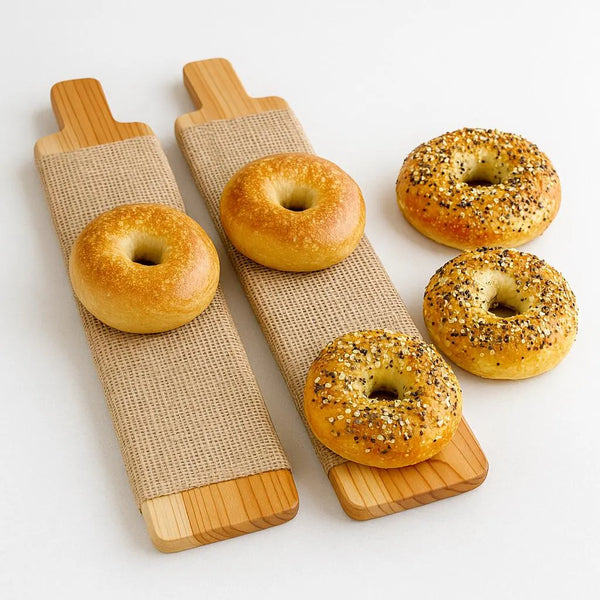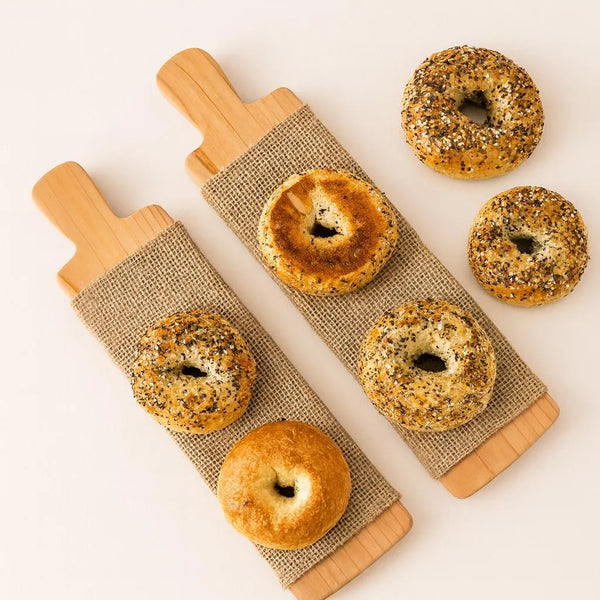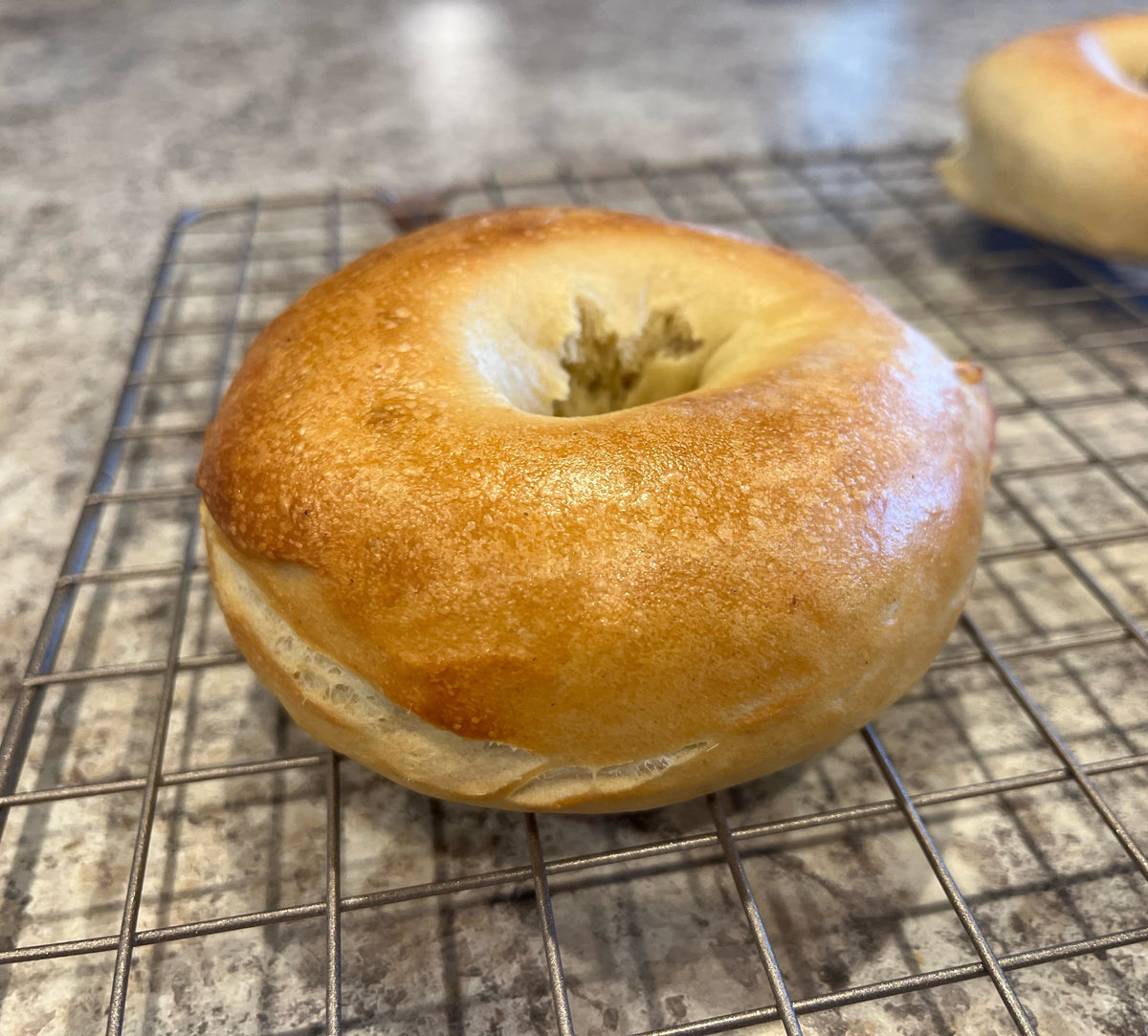
Bagel-shop bagels wear a shell: glassy and deep brown, sometimes freckled with tiny blisters. Home batches come out matte more often than not, and the internet's favorite fix is to paint on an egg wash.
You don't need the egg. The shine on a real bagel is built in the pot and set in the oven, and every part of it is a decision you control: how long you boil, what goes in the water, and what happens in the first minutes of the bake. Here's the system I use, with amounts.
The twenty-second boil
A proofed bagel goes into the water looking slack and a little wrinkly. Twenty seconds per side is all I give it, and that's enough to change the surface completely. The outer starches cook, the skin pulls tight, and the sugars in the water coat the surface and leave it slightly sticky. Cut a boiled bagel in half, or nick the skin, and you can see the work: a thin, clear outer layer, slightly darker than the pale dough inside. That layer is the crust, already forming before the bagel meets the oven. It's also most of why bagels are boiled at all; that pre-cooked skin is where the chew and the shine both live.
More time in the water doesn't buy more shine. Past a point the bagel does its rising in the pot instead of the oven, which is how you get a shiny, flat bagel.
Overboiling wrinkles skins too; that diagnosis is in Why Did My Bagels Wrinkle After Boiling?
What goes in the water
My water today is two tablespoons of barley malt syrup and a teaspoon of baking soda. Before that I used two tablespoons of brown sugar, two of honey, and the same teaspoon of baking soda, and it worked perfectly fine. Malt syrup isn't a requirement; it's the traditional New York flavor, and that's the reason to use it.
The sugars are the shine. Leave them out and you'll still get a great rise, but the crust comes out matte and dull. Sugar left on the surface caramelizes in the oven, and that caramelization is the deep color and gloss that makes a bagel look like it came from a shop.
Alkaline water raises the surface pH, which speeds the Maillard browning; that's the baking soda's job, and it's the same chemistry pretzels use at full strength. A teaspoon in a big pot is a nudge, not a pretzel bath. And since people ask about this one: yes, baking soda in a bagel boil is real, and it's there for color.
The oven sets it
Everything the water built has to survive the first minutes of the bake, because that's when the sticky, gelatinized skin dries into gloss, curing like the top coat on a finished board. Dry it out too fast and the skin sets dull and cracked; the surface needs to stay soft long enough for the ring to finish blooming underneath it. That's the job steam does. My bagels spend their first seven minutes at 450°F on soaked cedar boards, where wet burlap holds steam directly against the crust, and the shell hardens late and even with the bloom already done. The full mechanics are on our Why Bagel Boards page.

I'll be straight about my testing here: the steam mechanism above is standard crust science, not my experiment. I moved to boards because of seared bottoms and flat rings, and I haven't run a shine-only comparison with and without them.
If you want the blisters
Blisters show up on my bagels sometimes, though not often. If you want them, force them: a light spray of water over the bagels going into a hotter-than-usual oven, where the shock of high heat on a wet surface bubbles the skin.
The egg wash question
I'll give egg wash its due: it's a fair beginners' shortcut to the look, and it's completely unnecessary. Everything the wash promises, the boil already delivers, and most bagel shops don't egg-wash at all unless that's the specific style they're baking. It's also messy in practice: washed bagels can turn gooey before the bake, and too much egg bakes into a film of cooked egg sitting where the shine should be. If you're starting out it'll get you the look; once your boil is dialed in, you won't miss it.
For your next batch
The crust is a sequence: the water builds the coat, and the first minutes of steam decide whether it sets glossy or dull. In numbers: twenty seconds per side; two tablespoons of malt syrup (or two each of brown sugar and honey) and a teaspoon of baking soda in the pot; steam at 450°F for the first seven minutes; a water mist and a hotter oven for blisters. No egg.
Where to go next
The full process: the whole recipe in grams, dough through bake, is the Authentic New York Bagel Recipe.
The gear: the Classic Bagel Board and the Signature Bagel Board live in the boards collection.
The seeds: that sticky post-boil surface is also the moment toppings stick; the routine is in How to Make Everything Bagel Seasoning Actually Stick.